U.S. blockade of Cuba causes record losses in tourism between 2025 and 2026
Restrictions on aviation fuel, financial difficulties, and pressure on hotel chains limited the arrival of visitors and stifled the sector’s recovery prospects
Posted by Sol de Cuba, 27/10/2026
Damages to the tourism sector between March 1, 2025, and February 28, 2026, amount to 2,093,914,700 U.S. dollars. This is detailed in a report requested by the UN Secretary-General pursuant to Resolution A/RES/80/4, titled “Necessity of ending the economic, commercial and financial embargo imposed by the United States of America against Cuba”—a matter scheduled for debate and a vote at the United Nations on October 28 and 29.
Regarding air transport, finding alternatives has proven extremely difficult, given the impossibility of procuring the necessary fuel. In fact, just days after the announcement of the Executive Order on January 29, 2026, Cuba’s civil aviation authority had to announce that it could no longer supply aviation fuel (Jet A-1) at Cuban airports—a development with dire consequences, as it restricted the means for travelers to enter the country.
Objective: To dismantle the Cuban hotel industry
Furthermore, by the end of 2025, contracts with international tour operators had pointed toward favorable occupancy rates for the winter season beginning in early 2026. However, the imposition of the fuel blockade brought an abrupt shift to these recovery prospects. Executive Order 14404 has also led to the suspension of financial services that banking institutions previously provided to Cuba for the execution of its international transactions. It is no longer feasible to process payments via Visa and Mastercard on the island, as the banks that served as correspondents for Cuba have terminated these relationships, citing the risks they might face in relation to the United States sanctions.
This financial isolation has been a key objective in the U.S. strategy to cripple the Cuban economy.
The consequences extend far beyond uncompleted transactions. In reality, this renders it impossible to purchase shipments of food, raw materials for the production of medicines, or machinery for Cuban industry, among other impacts, regardless of whether the necessary funds are available.
Furthermore, the campaign launched by U.S. authorities following the enactment of Executive Order 14404 has had a clear goal: to dismantle the Cuban hotel industry, given the critical importance of tourism as a primary pillar of the country’s economy.
In early June 2026, several major international hotel chains with operations in Cuba terminated their management agreements for dozens of hotels in the country, fearing reprisals against their properties and bank accounts within the United States.
Under the umbrella of the May 1st Executive Order, the U.S. Department of State and the Department of the Treasury have initiated a veritable witch hunt against anyone conducting business with, or maintaining ties to Cuba. Given the extent of such actions, a second objective of this strategy has begun to emerge: in addition to inducing the collapse of the economic, political, and social system in Cuba, the aim is to deter any potential commercial rivals, with a view toward the ultimate goal of gaining total control over the island.
In the energy sector—leaving no doubt as to the comprehensive nature of this encirclement—the United States sanctioned the Cuban state-owned enterprise Unión Cuba-Petróleo (CUPET) on June 11, 2026, under Executive Order 14404. By doing so, the U.S. government blocked any commercial operations involving the large-scale supply of fuel to Cuba—such as those requiring the use of oil tankers. This applies even when the Cuban counterparties are private owners, as the transport, storage, and secure handling of such large quantities of fuel would inevitably require the use of CUPET’s infrastructure.
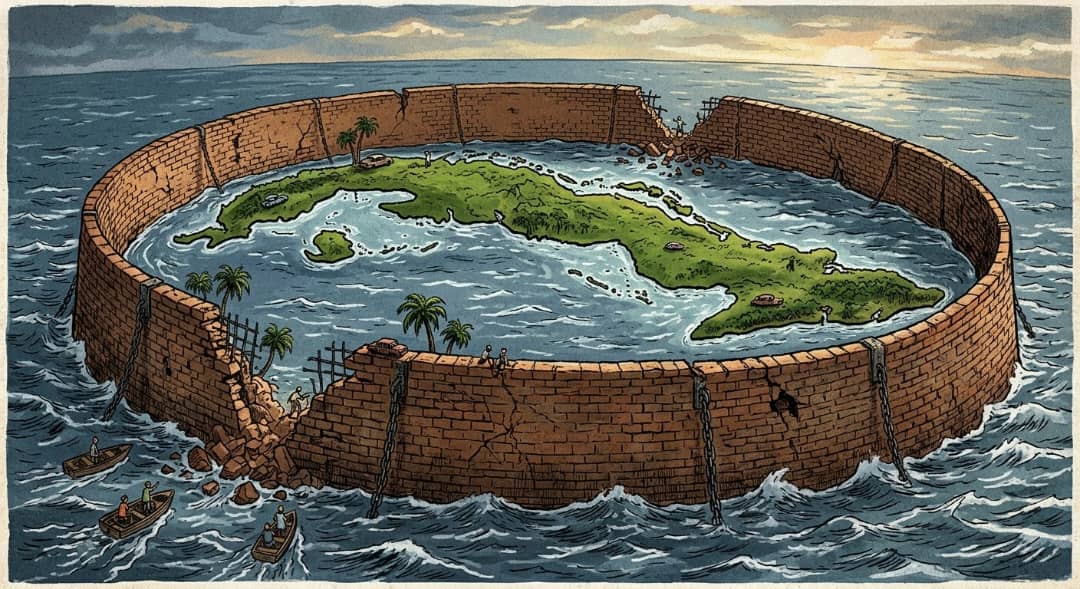
The application of these measures has created a sophisticated method of strangulation directed at the Cuban population—one that far exceeds the pressure exerted on the country over previous decades. After several months of these intensified coercive methods, the deterioration in the quality of life for the Cuban people—who were already pushing ahead with great stoicism due to the cumulative impact and hardships resulting from the blockade—has become starkly apparent.
No people deserves, nor should they be subjected to, such severe punishment simply for defending their right to self-determination.
Effects resulting from the application of the Helms-Burton Act
The implementation of the Helms-Burton Act—specifically Title III—along with the financial persecution resulting from Cuba’s arbitrary inclusion on the list of state sponsors of terrorism, have served as two key instruments in the “maximum pressure” policy against Cuba and the tightening of the blockade since 2019.
Title III of the Helms-Burton Act allows for lawsuits to be filed in U.S. courts against any individual or legal entity that has engaged in activities involving properties nationalized by the Cuban government.
This has acted as a significant deterrent to investment and business in Cuba, given the risk that foreign partners could face legal proceedings in U.S. courts.
On November 25, 2025, a new lawsuit was filed against the U.S. airline Delta by a plaintiff named José Ramón López Regueiro, who claims to be the legal heir to Havana’s José Martí International Airport.
To better understand the extraterritorial impact of the blockade on the tourism sector—and how it even infringes upon the rights of individuals in third countries—one can refer to an article published by the digital outlet The Pointer on January 21, 2026.
The piece tells the story of a Canadian family that, wishing to travel to Cuba, attempted to use reward points accumulated on their Toronto-Dominion Bank (TD) card to book flights and accommodation on the island through the platform Expedia. When they entered “Havana” into the site’s search engine, they received a message indicating that this was not an available option. The family learned that Expedia Group has blocked bookings to Cuba—even for non-U.S. clients—citing legal risks stemming from the U.S. blockade, including the application of the Helms-Burton Act.
The extraterritorial nature of the blockade has been reinforced
Furthermore, the absurd and arbitrary inclusion of Cuba on the fraudulent list of state sponsors of terrorism—compiled by the U.S. Department of State—has continued to serve as a major obstacle to the development of the Cuban nation. This measure has reinforced the extraterritorial nature of the blockade, as it has led international entities to exercise greater caution and distance themselves from Cuban counterparts for fear of U.S. reprisals.
This spurious and unilateral designation—for which the U.S. government has failed to produce a single piece of evidence—constitutes an instrument of aggression and deliberately ignores our country’s proven cooperation in the fight against terrorism. It is well known, including among U.S. law enforcement agencies, that far from sponsoring terrorism, Cuba has been a victim of this scourge and has strictly fulfilled its international commitments in this regard.
The economic consequences of this inclusion have been devastating. Between March 2025 and February 2026, 34 international banking entities suspended or refused to conduct transactions involving Cuba for fear of secondary sanctions, closing accounts or rejecting transfers intended for the purchase of food, medicine, and fuel. The Cuban economy lost traditional suppliers, who severed commercial ties to avoid the risk of being sanctioned. The unfavorable stance of financial institutions regarding the processing of payments, combined with the inability to access faster logistical routes, forced Cuba to incur high additional costs to acquire priority supplies. All of this has exacerbated the cumulative impact of the blockade and its erosive effect over time.
Digital platforms and technological services also suffered the consequences of this designation. There were instances where payments to Cuban hosts on accommodation platforms were suspended; email services provided to Cuban businesses by entities linked to U.S. companies were interrupted; and accounts belonging to solidarity campaigns—which were raising funds for donations—were closed.
Numerous Cuban diplomatic missions also faced serious difficulties with the banks that had traditionally provided them with services in various regions of the world. This hindered their operations and sustainability, including the processing of payments for consular services.
Throughout the period under review, the U.S. Department of the Treasury’s Office of Foreign Assets Control (OFAC) has continued to impose fines on companies that conduct business with Cuba. Although this practice is entirely illegitimate—as the United States has no authority to dictate matters between third parties—such actions are highly effective in discouraging any type of commercial ties with the island.
On July 2, 2025, OFAC mposed a fine of $608,825 on the private global logistics company Key Holding, LLC, based in Delaware, for alleged violations of the sanctions regime against Cuba. OFAC determined that between January 2022 and July 2023, Key Holding, LLC’s Colombian subsidiary—then known as Key Logistics Colombia SAS—managed the logistics for 36 cargo shipments from Colombia to Cuba.
On July 15, 2025, OFAC announced another fine, this time for $11,832,136, to be paid by the private global logistics firm Interactive Brokers, LLC (IB), based in Greenwich, Connecticut, or violations of its sanctions regime against Cuba. OFAC determined that between July 15, 2016, and January 31, 2024, IB provided brokerage and investment services to individuals residing in various countries, including Cuba.
Furthermore, the arbitrary designation of Cuba as a state sponsor of terrorism has been used as a justification to deny the approval of online travel authorizations for the U.S.—known as ESTA—to citizens of countries otherwise eligible for the program, if those individuals have visited the island.
Investments in beautiful Old Havana have declined
The Havana City Historian’s Office reports a notable decrease in investments made by the private sector in areas prioritized for restoration, a trend driven by the decline in tourism. This has resulted in a lower level of economic activity within the city’s heritage zones. In contrast, statistics from the Office indicate that during the latter part of the Obama administration, private sector investment in tourism-related activities—such as lodging, dining, and recreation—grew. Furthermore, this contributed, at the time, to an exponential increase in the restoration of properties in the Historic Center of Havana.
General impacts
The total value of the losses suffered by Cuba due to the blockade during the period from March 1, 2025, to February 28, 2026, reached a record figure of 8,083,300,000 USD—an increase of 7% over the already very high figure reported in the previous document.
The annex to this report details the impacts across various sectors of Cuban society. The cumulative damages incurred throughout the years the blockade has been in effect amount to 178,700,500,000 USD in current prices—4.7% higher than the figure reported previously. When accounting for the sharp rise in the price of gold against the dollar, this results in a cumulative total of 3,896,505,000,000 USD.
Had the blockade not existed, Cuba’s GDP in 2025 (at current prices) would have been 10.8% higher than the value estimated for that year.