Hotel Packard: Luxury and pleasure facing Havana’s Malecón
Hotel Packard occupies a privileged location very close to Havana’s Malecón. The surrounding landscape blends contemporary architecture with the historic charm of the Cuban capital
Posted by Sol de Cuba, 10/11/2026
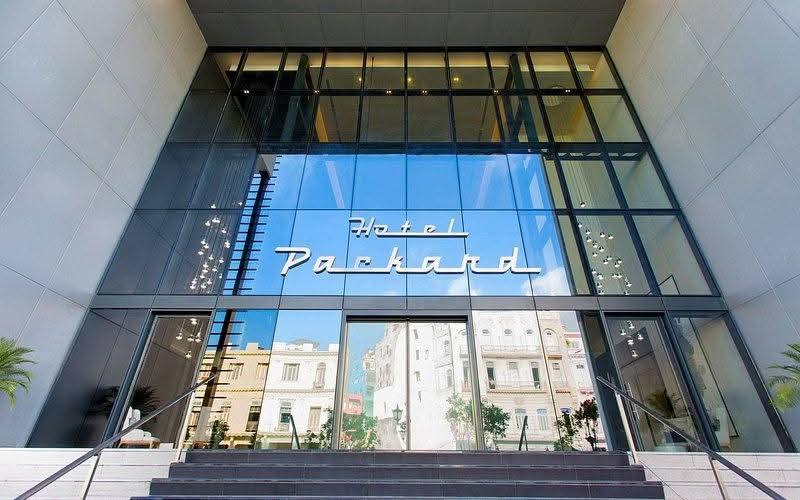
Hotel Packard occupies a privileged location very close to Havana’s Malecón. The surrounding landscape blends contemporary architecture with the historic charm of the Cuban capital, with the entrance to the bay and the Morro fortress visible from its windows.
Situated at the intersection of Paseo del Prado and Calle Capdevila, the property stands out to guests and passersby alike as an icon of luxury and modernity in the city’s historic district.
With 321 rooms, the Packard offers an experience tailored to those seeking exclusivity. It provides a comprehensive range of amenities, including a spa and gym for relaxation and well-being, as well as restaurants where guests can dine without ever leaving the hotel.
Among its most appealing features are the Cigar Bar—an essential stop for anyone wanting to savor a true taste of Cuba—and the panoramic terrace, an ideal spot for taking in views of the city and the sea.
For business travelers, the hotel also offers spaces for meetings and events, making it a versatile choice for both leisure travel and corporate gatherings or celebrations.
During its renovation, part of the original façade was preserved and integrated into a modern structure—a remarkable fusion of history and the present day.
The central courtyard, topped with a glass roof, and the striking open-air swimming pool on the sixth floor—offering beautiful sea views—are truly worth admiring.
A JOURNEY INTO THE PAST
On September 10, 2018, during the hotel’s inauguration, the late Historian of Havana, Eusebio Leal Spengler, praised the transformation of the former Biscuit Hotel—a small establishment that first opened in 1911—into what is now the beautiful Hotel Packard. “This is a project worthy of Havana and worthy of Cuba,” the historian asserted.
More than just a luxury hotel, this structure is a jewel of modern Cuban architecture.
Construction began in early 2015, with the aim of preserving a connection to the former facility that once occupied the site. The original façade—maintained for years by the Office of the Historian in anticipation of a new hotel that would restore the building’s original purpose—was kept intact.
The century-old front of the previous building remains up to the fourth level, above which rises the modern structure of the upper floors; this adds both value and a unique, compelling quality to the building’s contemporary appearance.
Following the demolition of the city walls in the second half of the 18th century, the land where the Packard now stands became part of an area that established itself as one of the most significant hubs in the old town of San Cristóbal de La Habana.
Over time, the property passed through various hands, gaining prestige as the city grew around it.
By the early 20th century, the Ulloa family—of Spanish origin and owners of several adjacent houses on the same city block—established the “Biscuit.” This well-known establishment catered exclusively to couples and travelers (excluding children) and offered modern amenities such as an elevator, private bathrooms with running water, and laundry services.
In 1931, the hotel was renamed, reflecting the wealth the Ulloa family had amassed and their role as the Cuban representatives for the American automobile brand, Packard. In fact, a showroom for Packard automobiles—and later for other brands—was located on Calle Cárcel, right next to the hotel, according to an account published on the Portal del Ciudadano de La Habana local government website. The hotel prospered, and the owners made investments, including the installation of a major broadcasting station, RHC Cadena Sur, and a hall with a capacity for 700 people, which hosted radio-related activities. The Ulloa family lived on the premises until their passing.
The Office of the Havana City Historian made efforts to preserve the building; when it was granted specific authority in 1994 to carry out major construction projects in Old Havana, it attempted to reconstruct the hotel, a task that proved not entirely feasible over the following two decades.